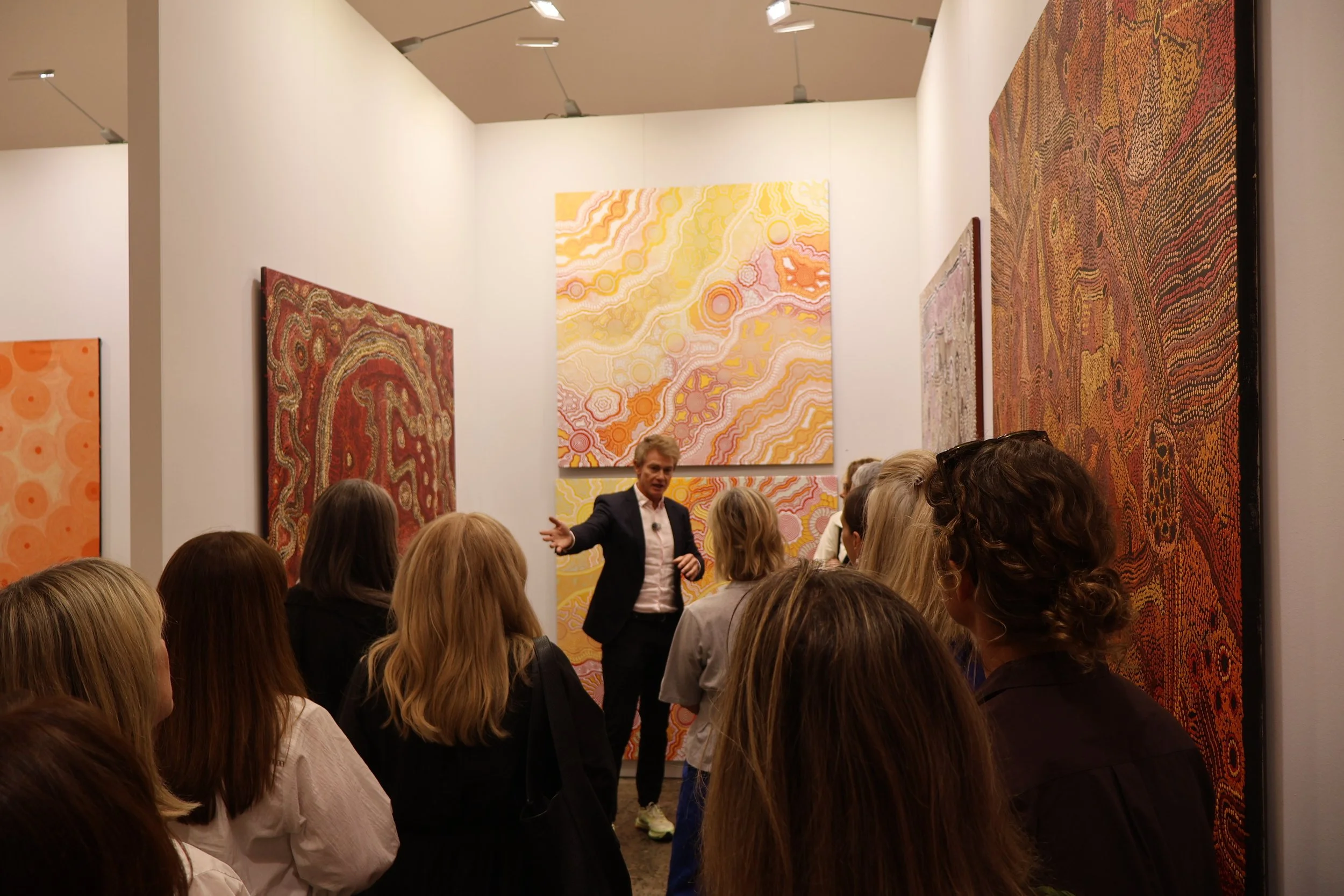
“Few art traditions have shaped modern abstraction while remaining so deeply anchored to place.”
STEVEN ALDERTON
AUSTRALIAN INDIGENOUS ART
Australian Indigenous art is one of the oldest continuous art traditions in the world, reflecting over 65,000 years of cultural knowledge, storytelling, and spiritual connection to the land. Created by Aboriginal and Torres Strait Islander artists, it encompasses a diverse range of styles, mediums, and practices, from ancient rock engravings and bark paintings to contemporary works in acrylic, sculpture, and digital media. Indigenous art serves as a profound expression of cultural identity, transmitting stories of the Dreaming (creation stories), ancestral connections, deep ecological knowledge and urban experiences of colonisation. Renowned globally for its intricate patterns, vibrant colours, and symbolic depth, this art form transcends visual aesthetics, offering audiences a powerful glimpse into one of humanity’s most enduring and profound cultural heritages.
Aboriginal artists have had a profound impact on international art, modernism, and abstract art. Artists like Emily Kam Kngwarrey and Rover Thomas have redefined contemporary art by blending deeply rooted cultural traditions with modernist and abstract aesthetics, creating works of extraordinary complexity, beauty, and spiritual resonance. Their paintings, characterised by intricate patterns, vivid colour fields, and powerful symbolism, have drawn comparisons to the works of Western abstract pioneers, yet remain distinctly grounded in Indigenous storytelling and connection to Country.
Emerging collectives like Tennant Creek Brio bring a raw, urban energy to this tradition, expanding its contemporary relevance. The strength of this art lies in its unique ability to bridge ancient cultural narratives with the universal language of abstraction, making it both visually compelling and culturally significant.
Emily Kngwarrey (above): A towering figure in Australian art, Kngwarreye’s groundbreaking abstract works, rooted in her deep cultural knowledge and connection to Country, exemplify the global significance of Indigenous visual language.
Rover Thomas: Known for his minimalist landscapes and narrative-driven art, Thomas’s works are pivotal in bridging Indigenous storytelling with modernist aesthetics, revealing deep connections to land and culture.
Warlimpirrnga Tjapaltjarri: Tjapaltjarri’s hypnotic and intricate desert paintings reflect sacred knowledge and ceremonial cycles, offering insight into the spiritual life of the Pintupi people.
Tjumpo Tjapanangka: Tjapanangka’s bold, dynamic use of colour and storytelling through desert iconography reflects a powerful continuation of ancestral tradition through contemporary means.
Ronnie Tjampitjinpa: A master of geometric abstraction, Tjampitjinpa’s work expresses the energy of ancestral stories with rhythmic, pulsating forms rooted in the Western Desert movement.
Mick Namarari Tjapaltjarri: Renowned for his subtle and atmospheric representations of landscape and ceremony, Tjapaltjarri’s works embody a quiet elegance and a deep sense of cultural continuity.
Nyunmiti Burton: A senior Pitjantjatjara Traditional Owner and cultural leader whose densely worked canvases carry the Kungkarangkalpa, the Seven Sisters, across Country and into the night sky.
Tiger Palpatja: A revered elder of Amata whose loose, saturated fields of colour brought a painterly freedom to the Wanampi Tjukurpa of the Piltati water snakes.
Ray Ken: A senior Pitjantjatjara man and cultural authority from Amata, whose restrained compositions hold the ancestral narratives of Tjala Country with quiet command.
George Cooley: A Coober Pedy opal miner whose thickly worked paintings read the colours of the Breakaways and the opal fields the way a miner reads the ground.
Yaritji Tingila Young: Traditional Owner for Amata and keeper of the Tjala Tjukurpa, whose sweeping arcs of colour have made her one of the most sought-after painters in the desert.
Tjungkara Ken: Her radiating fields of concentric line and vibrant colour map her home Country at Alkanyunta and the Seven Sisters travelling through it.
Gaypalani Wanambi: Winner of the 2025 Telstra Award and the 2026 Wynne Prize, her etched found metal carries the Wuyal honey hunter songline onto discarded road signs gathered on Country.
Gunybi Ganambarr: A Yolŋu innovator who incises and works industrial materials, bore casing, rubber and aluminium, into sacred designs, transforming what Arnhem Land painting can be made from.
Naminapu Maymuru-White: Her Milŋiyawuy paintings render the river of stars in luminous black and white, the Milky Way and the river of her Country held as one.
Barayuwa Munuŋgurr: A Djapu artist whose bold reworking of clan designs on bark and larrakitj moves Yolŋu painting into an unmistakably contemporary register.
Yalmakany Marawili: Working the sacred designs of her father's Country with a confident, expansive hand, she is among the strongest of the new generation at Yirrkala.
Dhambit Munuŋgurr: The first Yolŋu artist to paint in brilliant blue acrylic rather than ochre, a decision that opened an entirely new language for bark painting.
Djirrirra Wunuŋmurra: Her Yukuwa paintings take the yam and its root system into intricate, hypnotic pattern that has become one of the signature images of contemporary Yolŋu art.
Naomi Kantjuriny: A senior ngangkari and Elder of Amata who paints the mamu, the night spirits, capturing and holding them by the hundred across the surface.
Zaachariaha Fielding: A Mimili painter and musician whose raw, layered canvases hold the sound and movement of community gathering, and winner of the 2023 Wynne Prize.
Tuppy Ngintja Goodwin: Keeper of the Antara Maku Tjukurpa, whose luminous pale grounds and roundels of colour define the Mimili Pop movement.
Sandra Pumani: Her topographical canvases trace the Country around Mimili and the site where ancestor sisters sang the witchetty grub from the ground.
Betty Muffler: A ngangkari healer from Indulkana whose pale, intricately worked Ngangkari Ngura canvases are paintings made to heal Country and kin.
Iluwanti Ken: Her monumental black and white eagles, walawuru, hunting across vast canvases, carry her father's Tjukurpa with extraordinary graphic force.
Tennant Creek Brio: This collective’s radical fusion of traditional practices with urban and graffiti-inspired aesthetics challenges conventional forms and expands the reach of Indigenous art into new cultural territories.
Lin Onus: Onus’s innovative blending of Indigenous and Western artistic traditions offers complex, layered narratives of identity, place and environmental awareness.
Vincent Namatjira: Renowned for his satirical and politically charged portraits, Namatjira’s works blend humour and critique to address history, power and postcolonial narratives.
Kaylene Whiskey: Whiskey’s vibrant and playful narratives celebrate pop culture and Indigenous identity, combining comic-book aesthetics with community pride and cultural strength.
Ken Thaiday: Thaiday’s intricately crafted headdresses and kinetic sculptures draw from Torres Strait Islander traditions, merging ceremony with contemporary materials and movement.
These artists, among many others, represent the strength, innovation, and ongoing evolution of Indigenous Australian art. Their practices honour ancestral knowledge while engaging with contemporary life, global issues, and new artistic languages. From sacred traditions to bold experimentation, Indigenous art continues to shape the cultural identity of Australia and assert its place within the global story of contemporary art.