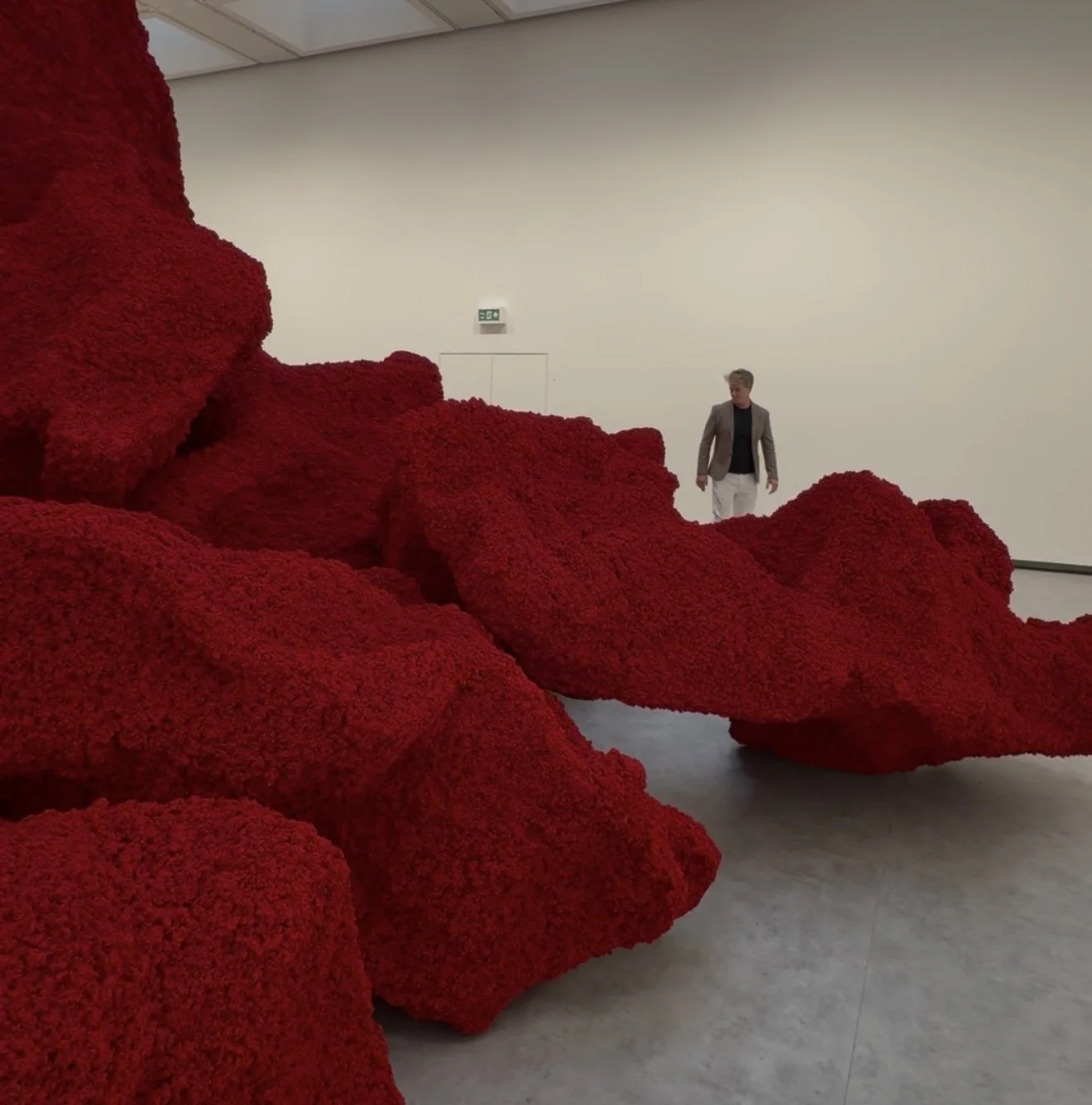
“From miniature to monsoon, these works hold the world in pattern rather than perspective”.
STEVEN ALDERTON
INDIAN ART
Indian art carries one of the longest continuous visual traditions in the world, running from the Ajanta caves and the temple sculpture of the south through Mughal miniature painting to a modernism forged in the years around Independence. That modernism was not an import. The artists who shaped it drew on Sanskrit and Persian aesthetics, on folk and tribal traditions from Mithila to Bastar, on the Bengal School's rejection of colonial academic painting, and on their own reading of Cézanne, Klee and Picasso, and they arrived at something that belongs to neither tradition alone. Contemporary Indian practice extends that inheritance into installation, video, photography, sculpture and performance, engaging caste, migration, religious violence, urbanisation and the environment with unusual directness.
The institutional infrastructure has matured rapidly. The Kiran Nadar Museum of Art, founded in New Delhi in 2010 as India's first private museum of modern and contemporary art, now holds more than 16,000 works from across South Asia and is building a new museum designed by David Adjaye that will become the largest art and cultural centre in the region. India Art Fair has reached its 17th edition and Art Mumbai brought together 73 Indian and 21 international galleries in 2026, with Perrotin, Richard Saltoun, Night Gallery and Niru Ratnam showing in India for the first time alongside returning international galleries including Lisson and Galleria Continua. Indian artists are held by Tate, MoMA, the Centre Pompidou and the Met, and the market for both modern masters and contemporary practice has strengthened accordingly.
Nalini Malani: A pioneer of video, shadow play and reverse painting on mylar, addressing the violence of Partition, gendered brutality and mythic memory.
Vivan Sundaram: A restless conceptual artist who moved from painting into installation and archive, reconstructing family and national history through photography and found material.
Nilima Sheikh: Her tempera and pigment works on paper and cloth carry the traditions of Indian miniature and mural painting into meditations on Kashmir, migration and women's lives.
Sheela Gowda: She builds sculpture and installation from cow dung, kumkum, human hair, rope and tar, materials carrying labour, ritual and gender into the gallery.
Dayanita Singh: A photographer who treats the book and the mobile wooden structure as the work itself, reordering images into portable, endlessly recomposable museums.
Subodh Gupta: Best known for monumental assemblages of stainless steel tiffin tins, buckets and utensils, turning the everyday objects of Indian kitchens into epic form.
Bharti Kher: Her sculptural language works through bindis, cast body fragments and found objects to explore hybridity, the feminine and metamorphosis.
Jitish Kallat: Working across painting, photography, sculpture and video, he sets the density of Mumbai street life against cosmology, time and historical speech.
Shilpa Gupta: A conceptual artist whose interactive installations, flapboards and sound works examine borders, surveillance, censorship and the words of imprisoned poets.
Amrita Sher-Gil: The pivotal figure of early Indian modernism, whose paintings fused European training with the flattened form and earth palette of Indian miniature and mural traditions.
V.S. Gaitonde: India's greatest abstract painter, whose luminous, meditative canvases were built in thin layers with roller and palette knife and now command the highest prices in Indian art.
F.N. Souza: A founder of the Progressive Artists' Group whose ferocious heads, nudes and church interiors made a modernism out of Goan Catholicism and open provocation.
S.H. Raza: His Bindu paintings distilled decades of French landscape painting into a single black seed form, geometry and colour standing for the origin of the universe.
M.F. Husain: The most prolific and public of the modernists, whose sweeping figurative line drew on Hindu epic, horses, cinema and Indian village life.
Tyeb Mehta: Known for the diagonal that splits his canvases and for the Kali, Mahishasura and falling figure series that respond to Partition violence with formal severity.
Akbar Padamsee: A painter of metascapes, cool inland landscapes composed entirely from the mind, alongside some of the most searching portrait heads in Indian art.
Ram Kumar: His abstracted views of Varanasi turned the city into fractured planes of grey and ochre, landscape emptied of people but heavy with them.
Nasreen Mohamedi: A singular figure who worked almost entirely in graphite and ink, building austere fields of line and diagonal that place her among the most rigorous minimalists anywhere.
K.G. Subramanyan: Painter, muralist, theorist and teacher at Baroda and Santiniketan, whose work deliberately closed the distance between fine art, craft and the popular image.
Bhupen Khakhar: India's great figurative storyteller, a self-taught accountant who painted shopkeepers, saints and homosexual desire with tender, unsparing candour.
Arpita Singh: Her densely populated canvases place ageing women, aircraft, flowers and guns into a dreamlike pictorial space that reads as both domestic and political.
Zarina Hashmi: Working in woodcut, etching and cast paper, she made the line itself a record of Partition, exile and the idea of home.
Mrinalini Mukherjee: Her monumental knotted hemp sculptures brought a wholly original fibre practice into the canon, part deity, part plant, part body.
Himmat Shah: A sculptor of bronze and terracotta heads, elemental and scarred, alongside an extensive body of drawing and silver work.
N.S. Harsha: His panoramic, multi-figure paintings hold hundreds of ordinary people in patterned repetition, tracing the comedy and scale of contemporary Indian life.
Anish Kapoor: Born in Bombay and based in London, his pigment-saturated forms, voids and polished mirror works made him one of the most significant sculptors of the last 40 years, a Turner Prize winner and Venice representative for Britain.
Rasheed Araeen: A Karachi-born pioneer in London whose minimalist lattice sculptures of the 1960s were made decades before the British art world was prepared to recognise them, and who founded Third Text.
Raqib Shaw: Kashmiri-born and working in London, his jewel-like enamel and glitter paintings on board reimagine Bosch, Holbein and Claude through the ornament of Kashmiri lacquer and papier mâché.
Rina Banerjee: Calcutta-born, New York-based, she assembles textiles, shells, feathers and colonial objects into hanging sculptures that speak to trade, migration and the mixed body.
Shahzia Sikander: Lahore-trained and based in New York, she took the discipline of Indo-Persian miniature painting into large-scale animation, mural and public sculpture.
Chila Kumari Burman: A British Punjabi artist whose neon, printmaking and self-portraiture drew on her father's ice cream van and Bollywood imagery, and lit up the facade of Tate Britain.