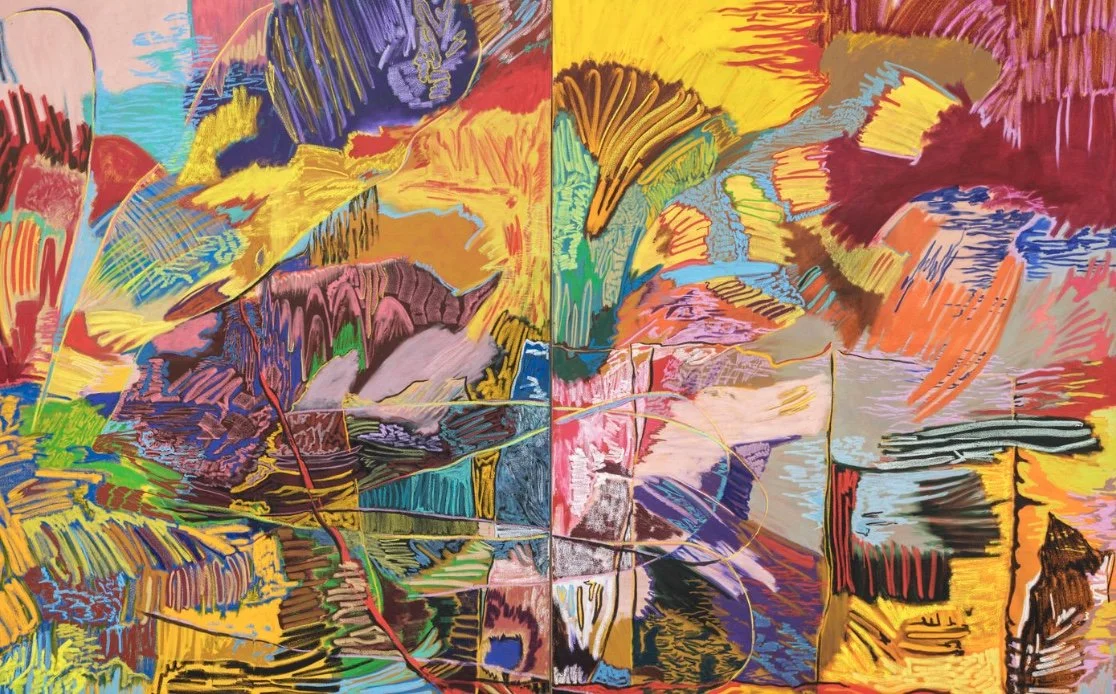
“From Bacon's rooms to Rachel Jones’ fields of colour, painting held its nerve and kept going”.
STEVEN ALDERTON
EUROPEAN & BRITISH ART
European and British art of the twentieth and twenty-first centuries is where the conventions of Western picture making were dismantled and rebuilt. Cubism broke the single viewpoint, Surrealism opened the interior, and the postwar decades pushed painting to its material limits, a slashed canvas, a burnt sack, a single field of blue. Much of that work was made against the memory of two wars, and its ambition was rarely decorative: Beuys came to art out of catastrophe, Kiefer painted German history into lead and ash, and the London painters of the same generation built pictures out of a city being rebuilt around them. British art took its own path, from the carved abstraction of St Ives to a figurative tradition that never let go of the human body, and then into the conceptual and installation practice that made London one of the two centres of the global art world.
The market and the institutions remain the deepest in the world. Tate, the Pompidou, the Stedelijk, the Prado, the Museo Reina Sofía and dozens of major private foundations collect at scale, the European fair circuit runs from TEFAF Maastricht and Art Basel to BRAFA and Art Paris, and the secondary market for postwar European painting sets the benchmarks against which the rest of the field is priced. A new generation is now moving very quickly, with painters in their late twenties and early thirties taken up by Gagosian, Pace, Hauser and Wirth and White Cube within a few years of graduating, and the Turner Prize continuing to set the terms of the conversation in Britain.
Jadé Fadojutimi: Her dense, high-keyed abstractions have made her the most commercially powerful painter of her generation, ranked second in the Hiscox Artist Top 100 for 2025 at $7,058,172 and first by wet paint lots sold in 2024, shown by Gagosian and Pippy Houldsworth.
Ewa Juszkiewicz: Her reworkings of historical portraiture, in which the sitter's face is obscured by hair, fabric or foliage, carry a median auction price of $506,908 and Gagosian representation.
Flora Yukhnovich: She paints the excess of Rococo into loose, dissolving abstraction, and is among the most sought-after painters at Victoria Miro.
George Rouy: His fused, elongated bodies in shallow atmospheric space took him to Hauser and Wirth before he turned 30.
Pam Evelyn: A painter of thick, gestural abstraction who joined Pace at 27 on the strength of two solo exhibitions since graduating.
Issy Wood: Her queasy, close-cropped paintings of car interiors, china and clothing are shown by Michael Werner and Carlos Ishikawa.
Louise Giovanelli: Her paintings isolate and repeat fragments of ritual and performance, a curtain, a candle, a mouth, with a survey at the Hepworth Wakefield and representation by White Cube.
Rachel Jones: Her exuberant oil pastel and oil stick abstractions centre on the mouth and teeth, with major presentations at Chisenhale and Dulwich Picture Gallery and representation by Thaddaeus Ropac (pictured).
Michaela Yearwood-Dan: Her large, floral, text-inscribed canvases build a language of celebration and community, and took her to Hauser and Wirth.
Caroline Walker: A painter of women at work, in kitchens, nail salons and hotel corridors, shown by GRIMM and Stephen Friedman.
Mohammed Sami: Baghdad-born and UK-based, his quiet, displaced interiors hold the memory of war without depicting it, and he was shortlisted for the Turner Prize in 2025.
Nnena Kalu: Winner of the Turner Prize in 2025, her vast wrapped and bound sculptural forms in tape, fabric and paper accumulate through sustained repetitive making.
Marguerite Humeau: Her sculptural and sonic environments reconstruct extinct bodies and speculative worlds, with Torches at the ARKEN Museum in 2025 and a Turner Prize 2026 shortlisting.
Pol Taburet: His spectral figures drawn from Caribbean spiritual traditions made him one of the most searched artists in the Artnet Price Database in the first half of 2025.
Nathanaëlle Herbelin: Her intimate domestic interiors, indebted to Vuillard, drew a solo presentation at the Musée d'Orsay in 2024 and a sharp rise in market attention.
Lynette Yiadom-Boakye: Her imagined portraits, painted in a single sitting with an extraordinary command of tone, placed Black figures at the centre of the European painting tradition.
Peter Doig: A painter of remembered and half-invented landscapes, snow, canoes and Caribbean light, and among the most influential figurative painters of his generation.
Marlene Dumas: Working from photographs and found images, she paints the human face and body in thin, fluid washes that carry unsettling psychological charge.
Rachel Whiteread: She casts the space inside and beneath things, a room, a staircase, the underside of a chair, turning absence into solid form.
Gerhard Richter: The most consequential painter alive, moving between photorealist grey paintings, colour charts and vast squeegeed abstractions without ever settling.
Anselm Kiefer: His monumental paintings and lead sculptures work straw, ash, clay and shellac into German history, myth and the aftermath of war.
Georg Baselitz: Best known for inverting his images so the picture is read as paint before subject, and for a body of monumental, deliberately coarse figuration.
Louise Bourgeois: Six decades of sculpture, drawing and installation drawn from memory, the maternal body and anxiety, including the monumental steel spiders.
Joseph Beuys: Sculptor, teacher and provocateur whose felt, fat, copper and performance work redefined what an artist could be understood to do.
David Hockney: From the Los Angeles pools to the Yorkshire landscapes and the iPad drawings, a painter of sustained curiosity about how looking actually works.
Bridget Riley: Her optical paintings, first in black and white and later in colour, make the eye itself the subject, an abstraction of pure sensation and rhythm.
Frank Auerbach: His heavily laden portraits and views of Camden Town were painted and scraped back hundreds of times, the image arrived at rather than composed.
Lucian Freud: A portraitist of unmatched scrutiny, building the human body from thick, worked paint across sittings that ran for months.
Francis Bacon: The defining British painter of the postwar era, whose distorted figures in glass cages and shallow rooms treat flesh, violence and isolation without consolation.
Barbara Hepworth: Her pierced and strung carvings in wood and stone brought abstraction into direct relation with landscape and the body, and made St Ives an international centre.
Pierre Soulages: Seven decades of black, culminating in the outrenoir paintings where light is reflected off the surface rather than described within it.
Yves Klein: His monochromes in International Klein Blue, his body prints and his fire paintings treated colour as an immaterial, almost spiritual substance.
Lucio Fontana: His slashed and punctured canvases moved painting into actual space, a single decisive cut opening the picture plane for everyone who came after.